Uncovering the Diamond
A song that stayed on my Xanga profile after another sexual assault was, “The Nobodies” by Marilyn Manson, ironically…
In a world where I felt invisible, the line “Today I’m dirty, I want to be pretty / Tomorrow, I know I’m just dirt,” landed in my 11- to 12-year-old soul like a spotlight, illuminating violations to my body that had been ongoing for several years of my young life. It was more than a lyric; it was a statement of validation. Being dirty, unclean, and used was already a built-in belief system assigned to me. Whether it was undiagnosed neurodivergence or symptoms of childhood sexual abuse, I knew from a young age that I was “bad,” “wrong,” “lying,” “manipulative,” and so on.
There’s a quote that I read many years ago; I don’t know the author or full context, but it goes something like, “Being a baby is such a nice way to start out as a human.” First, I agreed. Shortly after, I questioned the quote. I can absolutely appreciate how abundantly sweet babies are. We hear all the time: “Oh, they were such a good baby!” The measure of “goodness” is usually dependent upon how demanding an infant is to have their needs met, or the level of ease their caregiver feels meeting them. These statements are full of joy and good intention — but when do babies stop being “good?” What is “good?” At another glance, a baby that makes little effort to cue their caregiver to have their needs met may have experienced prolonged periods of time where their needs weren’t being met. They stop asking for their needs to be met. They, instead, self-soothed. Even in the absence of neglect, early independence seems to be praised.
I can’t speak for all survivors, but for me, as a child with unknown neurodivergence, a lot of my beliefs about myself, love, safety and relationships were built on the sexual abuse l endured as a child. Even the most innocent comments — “This is what love is,” “You’re so special,” and “You’re going to drive all the boys crazy when you’re older.” — fed into a system I was creating, along with the negative beliefs surrounding my responses to trauma, sexual abuse, and neurodivergence in general.
I believed my worth came from how I looked, how thin I could be, and how many of own needs I could ignore to appear “easier,” and to be more loved and accepted. As a young child, I realized that the violation I experienced caused anger in those around me, making me feel like I had done something bad. It is clear to me now why I had a fawn response, which only led to further encounters of abuse — abuse I had already learned to take responsibility for; abuse I spent decades trying to take control of. This cycle was on loop throughout my life, until I first found myself safe, unmasked, and truly sober. I started using substances when I was about 11- to 12-years-old because they kept me from having to feel. Using substances helped me to cope with beliefs I didnt even consent to. Go figure.
It wasn’t until I was 30-years-old that I realized l had been abused. This abuse that I never even knew existed didn’t only live in my body, but in my mind, my self-image, and in all of my relationships. Creating an illusion of control was my way to keep myself safe. My worth felt trapped in an 8-ball of rumination phrases, destruction far beyond what my mind could comprehend.
Enduring trauma changed me. When I entered into relationships in my adulthood, nothing felt normal unless it aligned with my beliefs. The little girl inside of me needed to control the amount of pain that other people could cause me. I was a master at creating my own chaos. My inner child inevitably evolved into my raging inner teen. She and I still have long heart-to-hearts sometimes.
In 2019, I started EMDR, which was the beginning unlearning all of the tricks and tales I had been going along with. Each layer peeled back a piece of me that required honesty, love, compassion, and forgiveness. It was a true balance of “who I am now” and “who I am becoming” — cycles of my own deaths and rebirths. Each session, I peeled back a bit more, pieces of every girl I had to be to protect who I thought I was. Life changed when I decided to change. I decided that it didn’t matter who said what about me because a lot of it wasn’t true, so I focused on what was true. The little girl inside of me finally remembered what was always good within me. The little girl inside of me is abundantly sweet. Owning my gifts felt like coming home after a long day of losing myself over and over again.
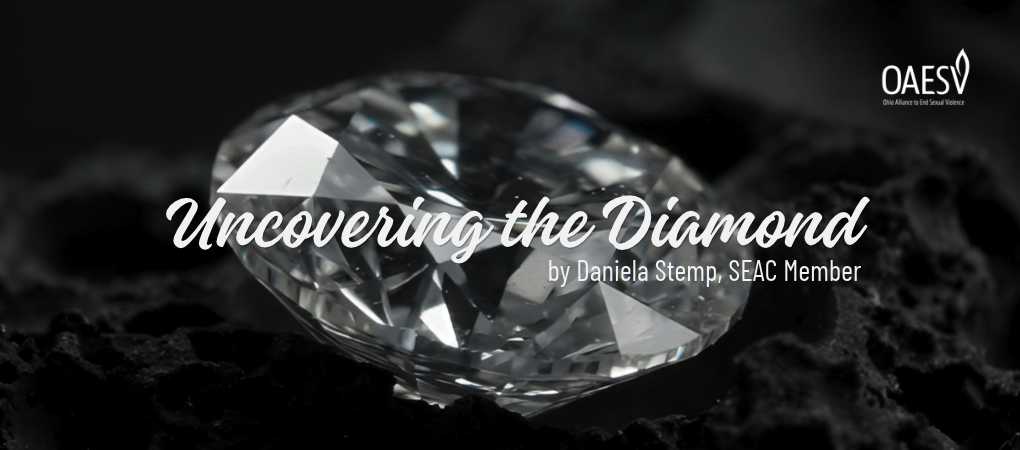
Who we are isn’t who we’ve been. But we are all of those things as well. My sensitivity and intuition were always within me. How do we recognize what is showing up? The challenge is removing the dirt that life and pain cover us in. Sometimes, we make mud out of it. Sometimes, no matter how hard we try to dust our shininess back, we end up just rubbing the dirt in. Sometimes, the mud hardens like clay. Eventually, I noticed a glow that started to require my delicacy. At times, residual dust would collect and dim my progress, but with practice, it was more easily brushed off. By the time I’m fully illuminated, I hope to be one diamond among the glow of survivors.
If you look inside, I hope you find that “little you”. I hope you keep going even on the days you feel unable to face. I hope you know that you can shine.
We all have a diamond to uncover. I’ve found it to be a worthy endeavor.
Learn more about our Survivor Empowerment & Advisory Council.
This publication was supported by the Rape Crisis Trust Fund, administered by the Ohio Attorney General’s Office. The opinions, findings, conclusions, and recommendations expressed are those of the authors and do not necessarily reflect the views of the Ohio Attorney General’s Office.